
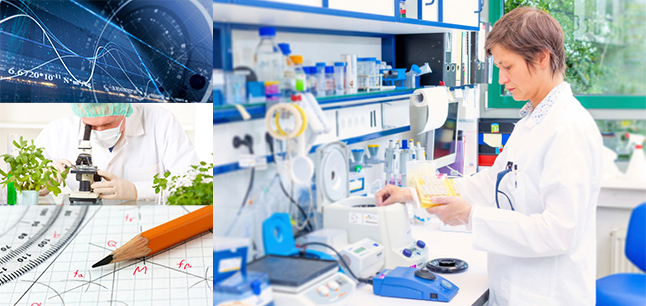
If you like the idea of developing new food products, testing anti-ageing serums, teaching, setting up businesses or studying the effects of pollution on marine life, then a career in science and mathematics may appeal to you.
You need to be logical, analytical, good at solving problems and accurate in your approach to work.
The science and mathematics career area includes the wide range of careers in the following sectors: biology and biological sciences; chemistry and material sciences; food science and technology; maths and statistics; physics and physical sciences, and general science.
If you think you may also be interested in other areas of technology you may want to look at the career areas for Engineering, Computing and ICT and Health and Medicine (including Medical Technology).
To see the routes to getting into each of these sectors, take a look at our Career Pathway.
Science and mathematics play a part in a wide range of industries, so you could find yourself working for retail companies to local government or research and development firms.
Job prospects in this career area still look promising, especially for highly qualified scientists and technicians, as the use of new technologies and products continues to grow.
In the academic year 2022/23, the percentage of science and maths graduates in full time employment after 15 months of graduating was: Biology 43.8%; Chemistry 51.4%; Physical and geographical sciences 56.7%; Physics 47.2%; and Maths 55%. 1
Business, HR & Finance was the top destination for physics graduates, with 19.3% of them entering this industry; the top professional job entered was physical scientist. For biology and chemistry graduates it was science professionals at 17% and 31.9% respectively. The highest percentage of physical and geographical graduates worked in business, HR and finance (17.2%), with the top job being environment professionals. 1
In terms of salary, in 2023 physics graduates earned the highest salary 15 months after graduation at £33,165 for females, and £33,580 for males, followed by chemistry graduates at £30,001 for females and £29,975 for males. 1
Scotland has world-class research expertise in areas that support industrial biotechnology including biology, advanced metrology, fermentation, big data, automation, and robotics. 2
Scotland’s life science sector employs over 46,000 people in businesses and higher education. This figure has increased around 10% every year during the past decade. It is one of the country’s most productive and high-growth sectors, providing high quality jobs and supporting better healthcare. 3
If you are interested in science careers you might want to visit Destination STEM which has lots of resources to explore.
1 What do graduates do? Prospects in association with AGCAS (2025/26)
2 Chemical Sciences and Industrial Biotechnology, Scottish Development International website (May 2026)
3 Life Sciences Scotland website (May 2026)
4 Sector Briefing - Life Sciences, Scottish Government (24 March 2026)
5 Health and Life Sciences Industries, Scottish Development International website (April 2026)
Courtesy of DYW Skills Academy


