A plumber uses a variety of tools to install and repair all forms of piping, drainage and central heating systems, both indoors and out. They also install appliances such as gas cookers and fires. They work in commercial and residential buildings.
The Work
You could be:
reading design plans to install new piping, tanks and valves throughout a building under construction
removing old and putting in new bathroom fitments in an occupied building
diagnosing faults in hot and cold water pipes, central heating systems, waste disposal and sanitation systems
choosing the right kind of pipe or joint for the job
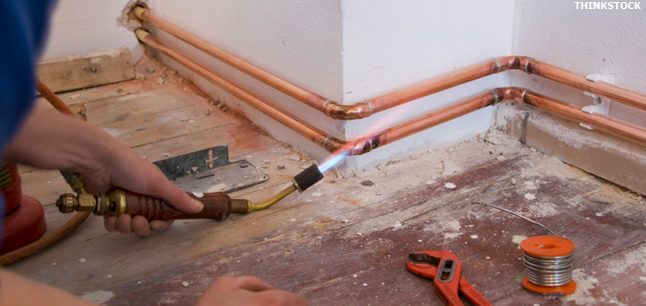
cutting, bending, welding and soldering piping into the right shape
installing cookers and fires that use gas, oil or solid fuel
visiting people’s homes to carry out repairs and responding to emergency calls about, for example, frozen or burst pipes in winter.
Pay
The figures below are only a guide. Actual pay rates may vary, depending on:
where you work
the size of the company or organisation you work for
the demand for the job.
Apprentice plumber rates for Scotland are set by the Scottish Joint Industry Board (SJIB), in line with the National Minimum Wage (NMW) and National Living Wage (NLW).
The hourly rate for a qualified plumber starts at around £16.00 rising to around £25.00 an hour.
Conditions
You may have to crawl into confined places, perhaps under floorboards.
You sometimes have to work in cold, dirty or smelly water when unblocking drains.
Outdoor work – and sometimes even indoor work – can be cold and damp.
You have to lift heavy items.
You sometimes wear protective clothing such as hard hat, overalls and safety goggles.
You would work around 37 hours a week. This may include some evenings or weekends and, in emergencies, callouts at any hour of the day or night.
The main way in is through a 4-year Modern Apprenticeship in Plumbing and Heating. In Scotland the organisation that handles Modern Apprenticeship training for the plumbing industry is the Scottish and Northern Ireland Plumbing Employers' Federation (SNIPEF).
SNIPEF do not employ apprentices or place them with an employer. You must find an employer willing to take you on as a plumbing apprentice.
To get into a Modern Apprenticeship in plumbing you need a minimum of 4 subjects at National 4 or 5, preferably including English, Maths and a technological subject.
You could study the Foundation Apprenticeship in Construction (SCQF Level 4 or 5) in S3-S6, which can help to get into a relevant Modern Apprenticeship.
You will have to pass a selection test as part of the application process.
A driving licence is useful and often essential.
You should be physically fit and may need normal colour vision.
To work on a building site you must get a SNIJIB CSCS (Construction Skills Certification Scheme) card. You must pass a health and safety test to qualify for this scheme.
Look for a job with private firms, local authorities, gas companies and the chemical industry.
practical skills and an aptitude for working with your hands
the ability to solve problems
reliability and honesty
a pleasant manner with the public
a willingness to carry out unpleasant tasks
health and safety awareness
a good head for heights
physical strength to carry metal piping and other materials.
You need to be able to:
read technical drawings and plans
work carefully and methodically
work alone or as part of a team with other craftspeople.
Training
Training during an apprenticeship is mainly on the job with off the job training at college. You would work towards SVQ Plumbing and Heating at SCQF Level 7.
To work with gas appliances you must be registered with the Gas Safe Register. You can get more information on the website: www.gassaferegister.co.uk
Getting On
Once you have qualified, you can apply for the SNIJIB Plumbers Grading Card which will give you professional recognition to work in the plumbing industry.
With experience, you can move on to a supervisory job.
You might move into management.
Like many plumbers, you might become self-employed.





 2026
2026

