
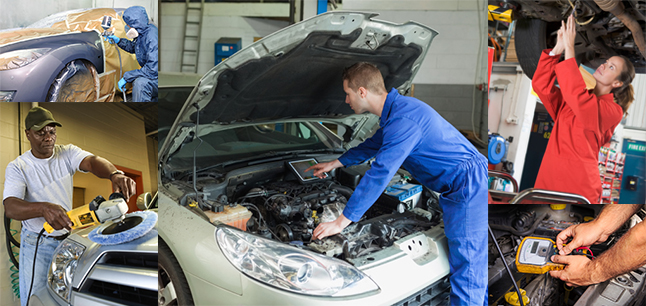
Do you enjoy working with your hands, and finding out how things work? Have you got a strong interest in motor vehicles, from cars and motorcycles to buses and trucks? If so, this career area might be the one for you.
The automotive industry is a vital part of the UK economy. In 2024 it employed 796,000 people, with 183,000 directly employed in the manufacturing sub sector. In recent years the industry has been shifting towards cleaner technologies, in line with the global move to zero emission mobility and is producing many of the key components required for zero emission vehicle manufacturing.1
This career area includes jobs in:
To see the routes to getting into each of these sectors, take a look at our Career Pathway.
Possible employers include:
You might be able to become a vehicle technician specialising in the repair and maintenance of vehicles used by emergency and rescue services, with organisations such as Police Scotland, the Scottish Fire and Rescue Service, airport fire and rescue services and the Scottish Ambulance Service.
There are also relevant opportunities in the Armed Services, particularly in the Army, for repairing and maintaining military vehicles, from light armoured vehicles to tanks.
According to the Institute of the Motor Industry (IMI) the UK motor trade sector faces acute labour market pressures, with particular demand for technical and specialist occupations. 3
Vacancy rates have remained steady at around 2.7%, leaving approximately 16,000 roles unfilled across the sector. Although vacancies have fallen by around 20% over the past two years, this reflects more selective hiring by employers rather than a reduction in demand. Skills shortages are most acute in body repair and paint roles, driven by a decline in apprenticeship uptake in this area. 2
Employers also report shortages of experienced workshop-ready technicians, particularly in diagnostic roles. Demand remains strongest in manufacturing, body repair and fitting. 2
Notably, Glasgow recorded the highest number of automotive technical job postings anywhere in the UK. 2
Women remain underrepresented in the automotive sector, making up only around 18.6% of the workforce (compared with over 50.8% nationally), and just 10.4% of senior roles. However, some sub-sectors, such as vehicle leasing, have near equal representation of men and women and in some cases even a female majority workforce. In contrast, many parts of the industry — particularly technical, manufacturing and repair roles — continue to be overwhelmingly male. 3
Most young people join the industry by doing a Modern Apprenticeship, which involves on the job training and going to a college or training centre on a part time basis. There is also the opportunity to start training at school with the Foundation Apprenticeship in Automotive.
The Institute of the Motor Industry (The IMI) is the sector skills council for the motor trade. You will find useful information on their careers website Autocity.
1 SMMT Motor Industry Facts 2026, The Society of Motor Manufacturers and Traders (SMMT) (February 2026)
2 Automotive Labour Market Briefing, The Institute of the Motor Industry (IMI) (March 2026)
3 Driving the future: Towards a more inclusive workforce, The Institute of the Motor Industry (IMI) (August 2025)
Institute of Motor Industry


